
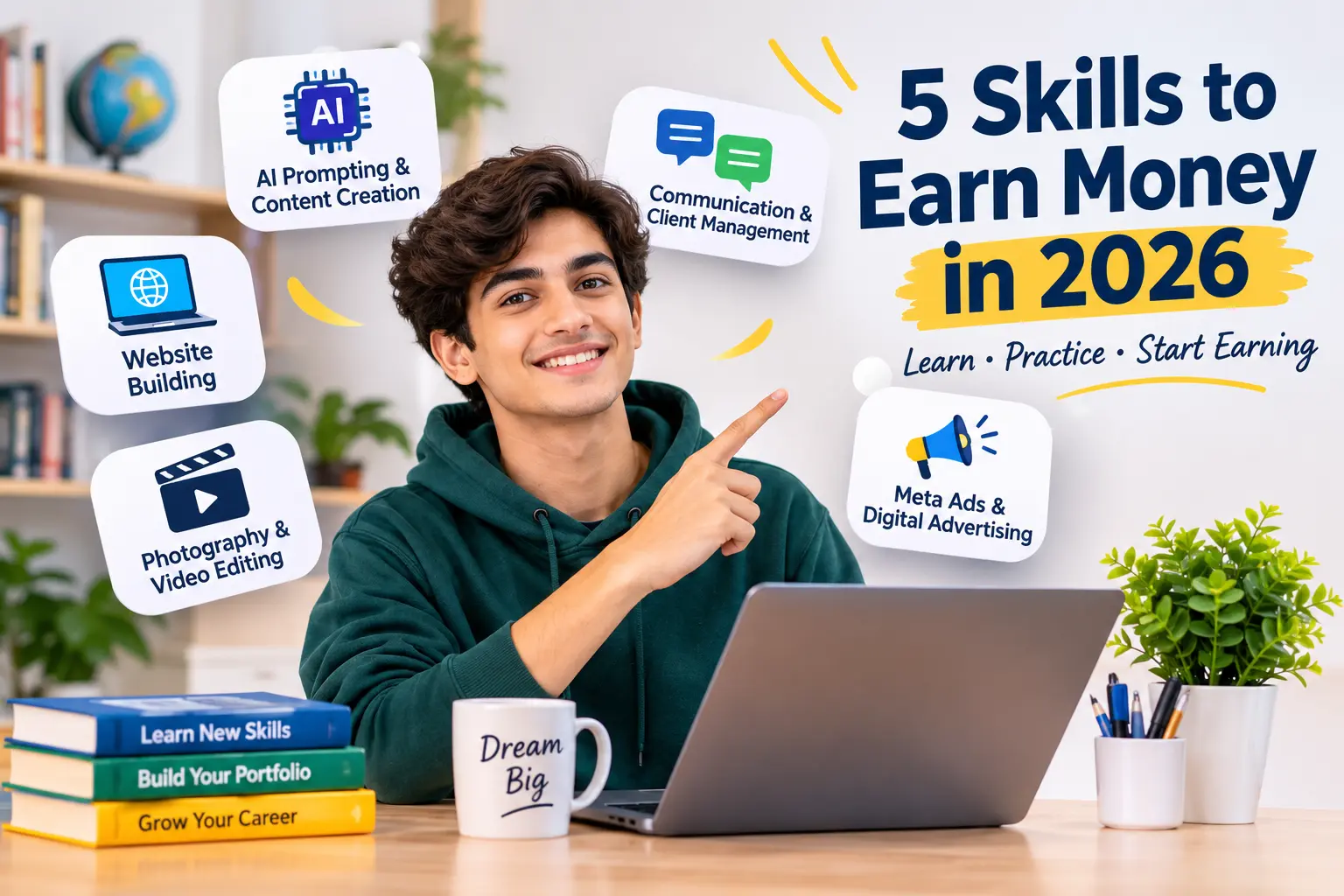
5 Skills Students Can Learn to Earn Money in 2026
You don’t have to wait until you graduate to start developing skills that can help you earn money. If you’re a student, this is a great time to explore what you’re good at, gain practical experience, and learn how to solve problems that businesses are willing to pay for.
The good news is that you don’t necessarily need a degree, expensive equipment, or years of experience to get started. Many students begin with free learning resources, practise on small projects, and gradually build the skills they need to find work.
Some options worth exploring in 2026 include AI-assisted content creation, website building, video editing, communication, and digital advertising. Each offers a different path, so the best choice depends on your interests, available time, and the type of work you enjoy.
In this guide, we’ll look at five useful skills students can learn, the services they could eventually offer, and practical ways to start building experience. We’ll also cover how students in Pakistan can explore freelance opportunities without falling for unrealistic earning promises.
1. AI Prompting and AI-Assisted Content Creation
Artificial intelligence tools have made it easier to brainstorm ideas, organise information, and create initial drafts. However, getting useful results takes more than typing a few words into a chatbot.
AI prompting is the ability to give an AI tool clear, specific instructions so it can help you complete a particular task. You explain what you want, who the content is for, and what the final result should look like.
Tools such as ChatGPT and Google Gemini can assist with writing, content planning, research, and marketing tasks. But the real value comes from knowing how to guide these tools, check their work, and turn their output into something genuinely useful.
What can you do with this skill?
Once you’ve developed your skills, you could explore services such as:
- Writing social media posts for small businesses.
- Preparing scripts for YouTube videos and short-form content.
- Creating product descriptions for online stores.
- Planning blog topics and content calendars.
- Helping businesses organise research and marketing ideas.
For example, a small clothing business might need a month’s worth of social media content. You could use AI to brainstorm ideas, draft captions, and organise a posting schedule. You would then edit everything to match the business’s tone, verify important details, and make sure the posts are relevant to its customers.
That final editing and quality control matter. Businesses need accurate, original, audience-focused content—not simply text copied from an AI tool.
How to get started
Step 1: Learn the basics. Start with OpenAI’s prompt engineering guide or Google Prompting Essentials.
Step 2: Practise with realistic examples. Choose a fictional business and ask an AI tool to prepare a social media calendar, write a few captions, or suggest video topics.
Step 3: Learn to improve the results. Experiment with different instructions. Check facts, remove generic language, and rewrite anything that sounds unnatural or doesn’t meet the task’s requirements.
Step 4: Create a small portfolio. Put together three to five strong examples, such as a content calendar, a video script, and a set of product descriptions.
One important thing to remember: Learning to use AI doesn’t automatically make you a professional writer or marketer. Your ability to judge quality, understand an audience, and deliver reliable work is what makes this skill valuable.
2. AI-Assisted Website and Landing Page Building
Almost every type of business needs a way to explain what it offers online. A local gym might want to display its membership plans, while a tutor may need a website where students can learn about classes and get in touch.
Website-building tools, including those with AI features, can help beginners create websites more quickly. You don’t necessarily have to start by learning advanced programming, although understanding basic web concepts will make you more capable as you progress.
The important thing is to build websites that work well for real people, not just designs that look attractive in a screenshot.
What services could you offer?
You could practise building simple websites for:
- Gyms and personal trainers.
- Tutors and coaching centres.
- Restaurants and home-based food businesses.
- Freelancers and independent consultants.
- Small shops and local service providers.
Imagine creating a sample website for a fictional fitness centre. It could include a homepage, details about classes, trainer profiles, contact information, and a form for membership enquiries.
A project like this gives you something concrete to show potential clients, even if you haven’t worked with a paying customer yet.
How to start learning website building
- Understand the basics. Learn about page layouts, headings, navigation menus, images, forms, and buttons that encourage visitors to take action.
- Choose a tool. Explore a website builder or an AI-assisted development platform that fits your budget and experience.
- Build a practice website. Pick one type of business and create a simple site around its needs.
- Test the design. Open it on a computer and a mobile phone to check that the layout is easy to use.
- Check every feature. Test links, forms, contact information, and other important functions.
- Prepare it for your portfolio. Explain what the website does and which parts you could customise for a real business.
As you improve, learn about domain names, hosting, backups, basic security, and ongoing maintenance. These are important when you’re responsible for a client’s live website.
If you’re just starting out, offer a clearly defined service, such as a basic informational website. It’s better to deliver a small project properly than to promise a complicated custom application you aren’t ready to build.
AI can speed up parts of the process, but it won’t automatically catch every broken link, inaccurate detail, accessibility issue, or security problem. Testing is still your responsibility.
3. Photography, Short-Form Video, and Video Editing
If you enjoy creating visual content, photography and video editing are worth considering. Businesses, content creators, event organisers, and online shops often need images and videos to showcase their products, explain their services, or connect with their audiences.
You don’t need to buy an expensive camera before you begin. A smartphone is enough to practise many fundamentals, including composition, lighting, framing, and basic video editing.
What matters at the beginning is learning how to make clear, engaging content and gradually improving the quality of your work.
What services could you offer?
Depending on your interests and equipment, you could work towards offering:
- Instagram Reels and YouTube Shorts editing.
- Product photography for small businesses.
- Promotional videos for restaurants and shops.
- Event highlight videos.
- Wedding reels and behind-the-scenes content.
- Editing footage provided by clients.
Short-form video editing can be a practical starting point because you can practise with relatively small projects. You can also create sample videos without needing to organise a large production.
How to build your skills
Start with one type of content. Instead of trying to learn every style of video production at once, focus on something manageable, such as editing 15–30-second vertical videos.
Practise the fundamentals. Work on framing, lighting, audio quality, pacing, captions, transitions, and keeping viewers interested. Choose an editing tool that works with your device and budget.
Create sample projects. Film a product at home, make a short promotional video for a fictional café, or edit footage you have permission to use.
Put together a portfolio. Select your strongest examples and organise them somewhere potential clients can view easily.
Reach out to relevant businesses. Show them examples that fit their needs and explain how your work could help present their products or services more effectively.
If you want to work on weddings or private events, agree on the deliverables, deadlines, payment terms, and permission to use the footage before starting. Always obtain appropriate consent before publishing identifiable people in your portfolio, particularly children or people appearing in private event footage.
Also, don’t build your entire plan around the hope that a video will go viral. Developing a strong portfolio, communicating professionally, and consistently looking for suitable clients are more practical ways to build a career in video editing.
4. Communication and Client Management
Communication might not seem as exciting as AI or video editing, but it’s one of the most useful skills you can develop as a student.
Think about it: a talented video editor still needs to understand what a client wants. A website designer must explain what is included in a project. Someone managing advertising campaigns needs to present results clearly.
Technical ability matters, but clients also want to work with people who listen carefully, ask sensible questions, and keep them informed.
Four communication skills worth developing
1. Speaking clearly
Practise explaining ideas in simple language. You don’t need complicated vocabulary or a perfect accent to communicate well. The goal is to help the other person understand you.
2. Listening carefully
Before suggesting a solution, make sure you understand the other person’s needs. Ask follow-up questions when instructions are unclear rather than making assumptions.
3. Writing professional messages
Learn to write clear emails, proposals, project updates, and client messages. Good writing helps prevent misunderstandings and makes it easier to agree on the details of a project.
4. Managing client expectations
Before starting work, clarify the deadline, deliverables, number of revisions, payment terms, and responsibilities of both sides. These conversations can prevent many problems later.
A simple daily exercise
You can practise communication without paying for a course. Set aside 15–20 minutes a day and try the following:
- Record yourself explaining a topic you understand for one minute.
- Listen to the recording and notice where your explanation could be clearer.
- Rewrite a short professional email or message.
- Practise asking questions about a hypothetical client project.
- Summarise a client’s requirements before suggesting a solution.
Ask a teacher, friend, or experienced person for feedback whenever possible. Small improvements become easier to recognise when someone else points them out.
Communication also involves understanding the situation. Eye contact and body language can be useful in some settings, but confidence looks different for different people and cultures.
If you plan to freelance, this skill can help you turn an initial enquiry into a clear agreement and maintain a better working relationship throughout the project.
5. Meta Ads and Digital Advertising
Have you ever seen an advertisement for a local restaurant, clothing brand, or online shop while scrolling through Facebook or Instagram? Businesses can use Meta’s advertising tools to promote their products and services to selected audiences.
Meta Ads is the name commonly used for paid advertising campaigns run through Meta’s advertising platform. Businesses may use these campaigns to generate enquiries, attract visitors, increase sales, or achieve other marketing goals.
Learning to create an advertisement is only one part of the job. A capable advertising specialist also needs to understand the business objective, audience, creative material, budget, tracking, and campaign results.
What should you learn first?
Start by understanding how to:
- Choose a campaign objective that matches the business goal.
- Understand audiences and advertising placements.
- Prepare suitable images, videos, and ad copy.
- Set budgets and schedules.
- Monitor campaign performance.
- Explain results and identify areas for improvement.
A useful starting point is Meta Blueprint’s official advertising courses. These learning resources cover topics related to campaign setup, audience selection, creative development, budgeting, and measurement.
How can students practise Meta Ads?
You don’t have to spend money on an advertising campaign just to begin learning.
Start by studying how different businesses present their products and services. Then create a mock campaign plan for a fictional gym, tutoring centre, or local shop.
Your plan could include:
- The business’s main advertising goal.
- The audience you want to reach.
- An example advertisement and its copy.
- A proposed budget and schedule.
- The results you would measure to evaluate performance.
Once you understand the basics, you can use this sample plan to demonstrate your thinking to potential clients.
Be careful about making promises. No beginner should guarantee a specific number of sales or leads without reliable evidence. Results depend on many factors, including the offer, competition, audience, creative quality, landing page, and budget.
If a business trusts you with its advertising, get approval for the budget and campaign settings before launching anything. Use the appropriate account permissions, protect access to business accounts, and report the results honestly.
Remember, you’re handling someone else’s money. Responsible decisions matter just as much as technical knowledge.
Which Skill Should You Learn First?
You don’t need to master all five skills at the same time. In fact, trying to learn everything at once can make it harder to become good at any one thing.
Start with a skill that matches your interests and gives you opportunities to practise regularly.
| Skill | A good starting point | Portfolio example |
|---|---|---|
| AI-assisted content creation | Writing and research | Social media content calendar |
| AI-assisted website building | Design and problem-solving | Website for a fictional business |
| Video production and editing | Visual storytelling | Short promotional video |
| Communication and client management | Speaking and writing | Client proposal and project brief |
| Meta Ads | Marketing and analysis | Sample campaign plan and reporting template |
If you enjoy writing, try AI-assisted content creation. If you like design and solving practical problems, website building may be a better fit. If you prefer creative work, explore video editing.
You can combine related skills later. For example, a video editor might add content planning to their services, while someone who builds websites might eventually learn digital advertising.
These are starting points, not guaranteed routes to employment or income. Your progress will depend on how well you learn, the quality of your work, and whether there is demand for the service you offer.
A Practical Six-Month Plan for Students
Once you’ve chosen a skill, the next challenge is knowing what to do with your time. Watching tutorials can help, but real progress comes from applying what you learn.
Here’s a six-month plan you can adapt to your study schedule.
Month 1: Choose One Skill
Explore a few options and decide which one you want to focus on. Find suitable beginner resources and identify the tools and basic concepts you need to learn.
You don’t need to buy expensive software or enrol in a costly course straight away. Start with resources that are accessible to you.
Month 2: Practise Regularly
Set aside a manageable amount of time each day or week. Follow tutorials, but make sure you complete the exercises yourself.
For example, if you’re learning video editing, edit short clips rather than spending the entire month watching editing tutorials.
Month 3: Build Your First Portfolio
Create two or three sample projects that demonstrate what you can do. Review your work, fix mistakes, and ask someone knowledgeable for feedback.
Don’t worry if your first attempts aren’t perfect. The purpose is to identify weaknesses and improve them.
Month 4: Decide What Service You Can Offer
Think about who might benefit from your skill and what you can realistically deliver.
Instead of advertising yourself as someone who can do everything, define a specific service. For example, you might offer short-form video editing for small businesses or simple websites for local service providers.
Prepare a short description of your service and organise your best samples into a portfolio.
Month 5: Start Looking for Opportunities
Begin contacting relevant businesses, applying for suitable freelance projects, or sharing your work professionally online.
Personalise your messages. Explain why your service may be useful to the person you’re contacting, and include relevant samples when appropriate.
You may not receive many responses at first. That’s normal. Pay attention to the feedback you get and look for ways to improve your approach.
Month 6: Review Your Progress
Look back at what you’ve achieved. How many samples have you completed? Have you received enquiries or feedback? Which parts of your work still need improvement?
Keep track of your outreach, responses, completed projects, and lessons learned. If your approach isn’t working, review your portfolio, service description, and target audience before spending more money on tools or training.
Six months gives you a useful period to build a foundation, but it doesn’t guarantee that you’ll find paying clients within that time. Treat the plan as a guide rather than a deadline for earning money.
What about students in Pakistan?
Students in Pakistan can explore local businesses and eligible online freelance opportunities. However, not every website or payment service supports every country, and platform rules can change.
Before signing up, check the platform’s current country eligibility, identity-verification requirements, fees, withdrawal methods, and payment policies.
For example, Upwork’s beginner guide explains important parts of freelancing, including profiles, proposals, portfolios, and working through platform contracts.
Research each platform before relying on it for work. Make sure you understand how you can receive your payments and what requirements apply to your account.
Common Mistakes Students Should Avoid
Learning a new skill takes patience. A few common mistakes can make the process more frustrating than it needs to be.
Trying to learn too many skills at once: Choose one main service and develop it until you can produce work you’re comfortable showing to others.
Collecting certificates without practical experience: Courses can provide useful knowledge, but sample projects help demonstrate what you can actually do.
Expecting to earn money immediately: Finding clients takes time. Focus on improving your skills and building a portfolio instead of treating quick income as a guarantee.
Using AI-generated content without checking it: AI tools can produce inaccurate information, repetitive writing, and unsuitable recommendations. Review everything before delivering it to a client.
Spending too much money on courses: Start with free or affordable learning resources. Consider paid training only when you understand what you need to improve and what the course offers.
Ignoring the details of a project: Clarify deadlines, deliverables, revisions, and payment terms before accepting work.
Trusting unrealistic job offers: Be cautious of guaranteed-income promises, recruitment fees, suspicious upfront payments, and requests for unnecessary personal or financial information.
Pretending practice work is professional experience: It’s perfectly fine to include sample projects in your portfolio. Just label them honestly instead of presenting fictional businesses as paying clients.
When using freelance marketplaces, read their current terms and understand their payment protections. Never assume that every opportunity advertised online is genuine.
Frequently Asked Questions
1. Which skill is best for students to earn money in 2026?
There isn’t one skill that’s best for every student. AI-assisted content creation may suit people who enjoy writing, website building may appeal to those interested in design and problem-solving, and video editing may be a good fit for creative learners.
Choose a skill that interests you, practise it consistently, and look at what potential clients actually need.
2. Can I learn these skills for free?
Yes, you can begin learning all five skills using free tutorials and official learning resources.
Some tools offer paid features, and certain freelance platforms may charge service fees or require paid application credits. Check the current terms before spending money.
3. Can students in Pakistan earn money through freelancing?
Students in Pakistan can pursue freelance work when the relevant platform, client, and payment arrangements allow it.
Your options will depend on platform eligibility, competition, your skills, and available withdrawal methods. Before accepting work, confirm that you can receive payments through a supported service and understand any applicable fees.
4. How long does it take to earn money from a new skill?
There’s no fixed timeline. Some people may find suitable opportunities sooner than others, while some need more time to improve their work and attract clients.
Your progress depends on your starting knowledge, practice, portfolio quality, communication, and the demand for your service. Focus first on becoming capable of delivering work that meets a real client’s needs.
5. Do I need a laptop to start learning?
Not necessarily. A smartphone can be enough to begin practising communication, recording videos, and completing some AI-assisted tasks.
A suitable computer will generally make website development, detailed video editing, and advertising analysis easier. The equipment you need depends on the tools you choose and the kind of work you plan to offer.
6. Should I learn all five skills together?
For most beginners, it’s more practical to start with one main skill.
Once you have a solid foundation, you can add complementary skills. For example, a content creator might learn video editing, while a website builder might expand into digital advertising.
Learning related skills over time can help you offer more useful services without overwhelming yourself at the beginning.
Final Thoughts
You don’t have to wait until graduation to start preparing for your professional future. Learning a practical skill while studying can help you explore different career paths, gain experience, and understand what working with real clients involves.
AI-assisted content creation, website building, video editing, communication, and Meta Ads are five options worth exploring in 2026. Each requires practice, and none guarantees a particular income, but all can help you develop useful abilities.
Start with one skill. Practise regularly, build a few strong samples, ask for feedback, and look for opportunities to apply what you’ve learned. Be honest about your experience and careful when evaluating online job offers.
Most importantly, don’t measure your progress only by how quickly you start earning. Focus on becoming someone who can deliver useful, reliable work.
That foundation can help you explore freelance opportunities while you’re still a student and prepare for the next stage of your career.